Surfshark vs IPVanish (2026): Two Unlimited-Device VPNs, One Cheaper Renewal
Surfshark vs IPVanish is the matchup for households that want every device covered, because both VPNs let one subscription protect an unlimited number of devices at once. For most people Surfshark is the better buy: it renews at $79 a year against IPVanish's $99.99, runs all of its servers from RAM according to Surfshark, and has no logging case in its past. IPVanish makes sense if the smallest possible first payment matters most, or if you want antivirus bundled in at a lower tier.
The prices here were read from both pricing pages on 18 October 2026 and again on 26 October 2026, when both companies were running seasonal promotions, so the first-term prices will move; the renewal prices are the steadier figures to compare. Facts on audits and ownership come from the providers' own pages and published reports. As with every matchup on this site, we report no speed tests of our own.
Tale of the Tape
Red corner
Surfshark
NetherlandsNord Security group · Deloitte, 2025
Blue corner
IPVanish
USAZiff Davis · Schellman audit, 2025
Unlimited devices: a tie, with fine print
Neither provider counts your connections. Surfshark's pricing page says you can protect as many devices as you like, and IPVanish says it doesn't meter concurrent connections or app installs. That removes the usual reason to pick one VPN over another for a big household, so the decision moves to the rounds below.
Two details are worth knowing. Surfshark's free trial, unlike its paid plans, is limited to three devices until the trial ends. And unlimited means your own household's devices; read each provider's terms before sharing one login with people outside it. If you're weighing a capped VPN against these two, our VPN comparisons hub lists device limits for every provider we cover.
Trust record and audits
Surfshark takes this round. Its no-logs claim is backed by two Deloitte assurance reports under the ISAE 3000 standard, the latest announced in June 2025 after a first in 2023, and its Trust Center lists further security audits of its infrastructure by Cure53 and SecuRing. Surfshark B.V. is based in Amsterdam, its terms of service are governed by British Virgin Islands law, and since a merger agreed in 2022 it sits in the same group as NordVPN.
IPVanish has two no-logs audits to its name: Leviathan Security Group's in 2022 and a Schellman Compliance review finished in February 2025. Its weak point is history. In 2016, under a previous owner, IPVanish supplied US Homeland Security with connection data identifying a user, while its privacy policy promised no logging; the case was reported in 2018. The company has changed hands twice since and the audits cover today's service. We still count it, because a VPN's whole value rests on a promise you can't check yourself.
Server design
Surfshark says all of its servers run in RAM only, so nothing is written to a disk that could later be read. On IPVanish's side, the server-list page we read on 18 October talks of mixing hard-disk and RAM-only machines and flags locations one by one, even though its pricing page the same day claimed the whole network is RAM-only. We go with the more detailed servers page. Edge to Surfshark.
The protocol picture is closer. Both offer WireGuard. Surfshark adds post-quantum protection to WireGuard inside its apps automatically, obfuscates OpenVPN connections without being asked, and switches on its NoBorders mode when it detects a restrictive network. IPVanish offers several protocols, a kill switch and Double Hop routing through two servers.
Features and bundles
Feature for feature, this round is level. Surfshark's apps include Bypasser for split tunnelling on Windows, macOS, Android and iOS (not Linux), an ad and cookie-popup blocker, a rotating IP option and Dynamic MultiHop. IPVanish counters with split tunnelling, a kill switch, and a Threat Protection filter for ads, trackers and dangerous sites that works whenever the VPN is on, plus a small eSIM data allowance on every plan.
The bundles are where they diverge. Surfshark One adds an antivirus, breach alerts and Surfshark's Alternative ID tools; One+ adds data removal by Incogni and identity-theft cover. IPVanish's Complete tier brings antivirus and phone support, and its top Advanced tier throws in a terabyte of cloud storage plus a secure browser. On 26 October Surfshark priced One at exactly the same $67.23 as Starter for the first 27 months, which makes the antivirus tier free for the first term; it renews at $99 rather than $79.
Price over three years
IPVanish wins the first bill and Surfshark wins every bill after it. IPVanish Essential's 2-year plan cost $52.56 ($2.19 a month), renewing at $99.99 a year. Surfshark Starter's 2-year plan, with three extra months, cost $67.23 ($2.49 a month) for 27 months, renewing at $79 a year. For month-to-month buyers, IPVanish charges $14.99 and Surfshark's monthly plan renews at $18.95. Both have a 30-day money-back guarantee on their longer plans.
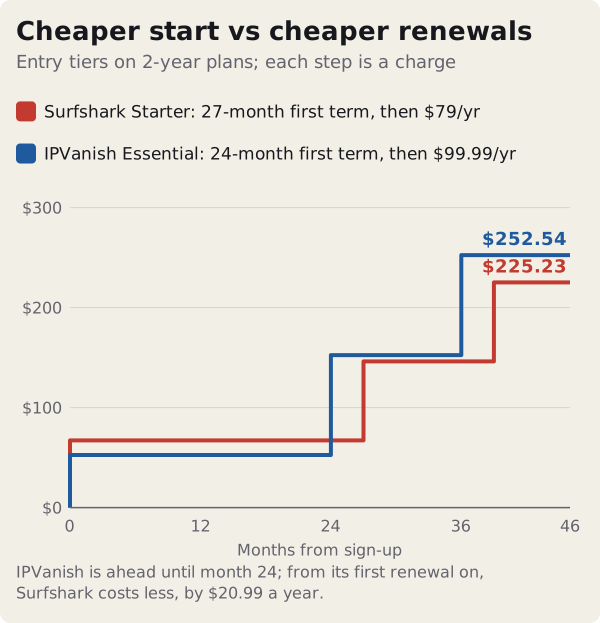
By month 36 you've paid $152.55 for IPVanish and $146.23 for Surfshark, and Surfshark's next charge doesn't arrive until month 39. From then on Surfshark costs $20.99 a year less. For the antivirus tiers the gap is $10.99 a year: $99 for Surfshark One against $109.99 for IPVanish Complete. One caveat from Surfshark's billing terms: the company may show different customers different renewal prices as a test, so the figure in your own account is the one that counts. For Surfshark against its sister brand, see Surfshark vs NordVPN.
Edge cases
- Linux users. Surfshark's split tunnelling isn't available on Linux, and its Flatpak build has no kill switch; use the .deb or Snap package instead.
- Monthly refunds. IPVanish printed its 30-day guarantee on yearly and 2-year cards but not on the monthly ones we read.
- Disk-based locations. On IPVanish, pick locations its servers page flags as RAM-only if that matters to you.
- Promotional labels. Surfshark called its 18 October prices a Black Friday deal and IPVanish ran a countdown offer; the renewal prices won't change with the promotion.
Surfshark vs IPVanish: the verdict
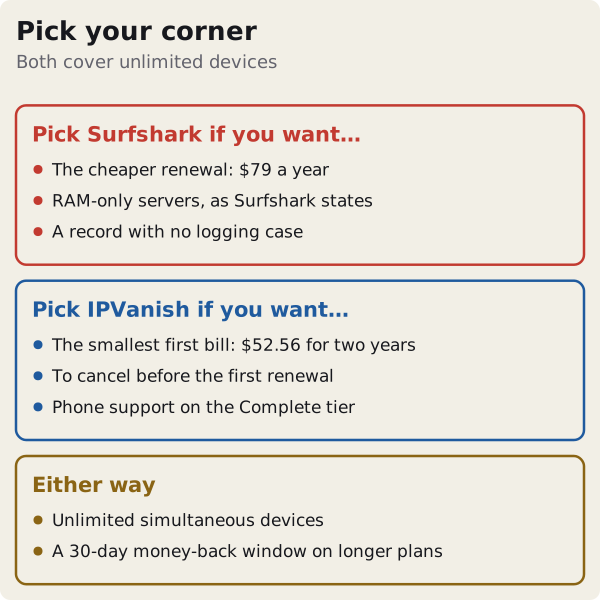
Take Surfshark if you want unlimited devices with the cheaper renewal, RAM-only servers and a clean record; it's the better long-term buy for most households. Take IPVanish if the lowest first payment matters most, if you'll cancel before the first renewal, or if its Complete tier's antivirus and phone support suit you. You can compare Surfshark's plans or compare IPVanish's plans; both links are affiliate links and don't change this result.
For more on IPVanish's record, read IPVanish vs NordVPN, or compare every pairing in the VPN comparisons hub.
Cornerside questions
Is Surfshark better than IPVanish?
Which is cheaper, Surfshark or IPVanish?
Do Surfshark and IPVanish both allow unlimited devices?
What is a good alternative to IPVanish?
Has IPVanish ever logged user data?
Affiliate links. We may earn a commission if you subscribe — it never changes who wins a round.
Zoom out: see how this sits in every VPN matchup, compared, or weigh the NordVPN vs Surfshark vs ExpressVPN three-way.