ExpressVPN vs IPVanish (2026): Same Renewal Price, Different Track Records
ExpressVPN vs IPVanish comes down to one trade. ExpressVPN runs every server from RAM and carries a 2025 KPMG assurance report; IPVanish lets you connect unlimited devices and costs less for the first two years. Take ExpressVPN if privacy architecture is the reason you're buying a VPN. Take IPVanish if you need to cover a lot of devices on one subscription and you're comfortable with a US company whose history includes a 2016 logging case.
Price barely separates them in the long run. Read on 26 October 2026, ExpressVPN Basic renews at $99.95 a year and IPVanish Essential at $99.99, so after the first term you'd pay almost exactly the same. The difference is up front: IPVanish's first two years cost $52.56, while ExpressVPN's first 28 months cost $83.72. We built this matchup from both providers' own pages and published audits. We ran no speed tests, and we don't publish any.
Tale of the Tape
Red corner
ExpressVPN
BVI lawKape · KPMG assurance, 2025
Blue corner
IPVanish
USAZiff Davis · Schellman audit, 2025
Trust record: the round that decides it
ExpressVPN takes this round. IPVanish's past is the reason: in 2016, under an earlier owner, it gave US Homeland Security connection data about a user suspected of sharing child-abuse material on IRC, at a time when its privacy policy said it would never log traffic or usage. The case came to light in May 2018. IPVanish had already been sold to StackPath in 2017, and in 2019 it passed to the J2 Global group whose media arm is now Ziff Davis, the New York company that owns it today.
Since then IPVanish has done what a provider in its position should: two independent no-logs audits, by Leviathan Security Group in 2022 and by Schellman Compliance, which completed its review in February 2025. That evidence covers the present service, and the 2016 episode tells you about a company that no longer runs it. Still, a VPN asks you to trust the operator with all of your traffic, and a documented failure is a fact worth weighing even years later.
ExpressVPN's record has no comparable incident in the sources we read. Its trust page lists KPMG reports from September 2022, December 2023 and June 2025, the last an ISAE (UK) 3000 Type 1 engagement assessing its TrustedServer system and privacy-policy claims as of 28 February 2025. Our VPN comparisons hub sets these audit dates against the rest of the field.
Server design and privacy architecture
This is ExpressVPN's second win. Its TrustedServer setup runs the operating system and apps entirely in RAM, so nothing persists on a hard drive and a reboot clears the machine. That limits what anyone who seizes or images a server can find, whatever the logging policy says.
IPVanish is harder to pin down. Its servers page, read on 18 October 2026, describes "a combination of HDD and RAM-only infrastructure" and marks individual locations; the copy on its pricing page the same day said the network "uses RAM-only technology". We take the more specific servers page as the accurate one, which means some IPVanish locations still use disks. If diskless servers matter to you, check the location you connect to in IPVanish's list before relying on it.
Jurisdiction is a smaller factor than it's often made out to be, but it points the same way. British Virgin Islands law governs ExpressVPN's terms of service, and its parent Kape is headquartered in London. IPVanish is a US company, and US courts can compel it directly. Neither base matters much if there are no logs to hand over, which is why the audits above carry more weight than the address.
Devices and household cover
IPVanish wins this round outright. It doesn't meter simultaneous connections at all, so one subscription covers every phone, laptop, console and streaming stick in a large household. ExpressVPN caps you at 10 devices on its Basic tier, rising to 12 with Advanced and 14 with Pro.
For most people 10 devices is plenty. But a family with several people, each running three or four devices, can hit ExpressVPN's cap, and upgrading to Pro for 14 connections costs $100 a year more at renewal. That is the scenario where IPVanish is the obvious value.
Features and apps
The two are closer here than their marketing suggests. ExpressVPN's apps run Lightway, its own protocol, which ExpressVPN says includes post-quantum protection using ML-KEM by default. Split tunnelling is available on Windows, macOS, Linux and Android, with a more limited website-bypass option on iOS. Its upper tiers bolt on a password manager, identity-theft alerts and insurance.
IPVanish offers WireGuard among several protocols, a kill switch, split tunnelling, Double Hop routing through two servers, and Threat Protection, which blocks ads, trackers and malicious sites while you're connected. Its Complete tier adds an antivirus and phone support, and Advanced adds 1 TB of cloud storage and a secure browser. Call this round a draw: the right extras depend on whether you want identity tools or antivirus.
Price and plans, read 18 October 2026
IPVanish is cheaper to start and ExpressVPN covers you for longer per payment. IPVanish Essential's 2-year plan costs $52.56 ($2.19 a month) and then renews at $99.99 every year. ExpressVPN Basic's 2-year plan includes four extra months, costs $83.72 ($2.99 a month), and renews at $99.95 a year. IPVanish also sells a monthly plan at $14.99; ExpressVPN's pages showed only 1-year and 2-year terms. Both companies were running seasonal promotions when we read their sites, so expect the first-term prices to move.
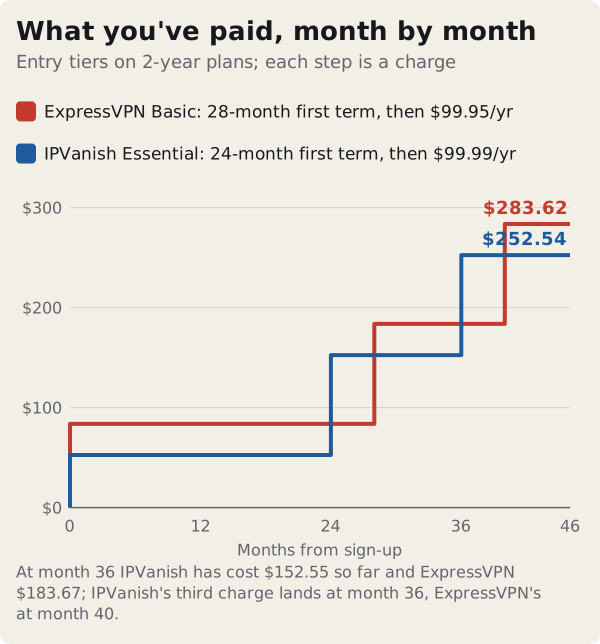
Over three years the totals are close. IPVanish reaches $152.55 for 36 months of cover, about $4.24 a month; ExpressVPN reaches $183.67 for 40 months, about $4.59 a month. After that, both cost roughly $100 every year. If you're weighing ExpressVPN's other matchups on price, ExpressVPN vs Surfshark shows a rival with a cheaper renewal.
Edge cases
- A refund on the monthly plan. IPVanish's yearly and 2-year cards print its 30-day guarantee; the monthly cards we read on 18 October didn't, so check before relying on it.
- You need a dedicated IP. ExpressVPN includes one only on Pro; on the lower two tiers it costs extra, and neither pricing page listed the add-on's price.
- Disk-based locations. If you use IPVanish for privacy-sensitive work, connect to locations its servers page marks as RAM-only.
- Tier creep. ExpressVPN's identity insurance and IPVanish's antivirus are bundled into higher tiers that renew at $119.95 to $199.95 and $109.99 to $129.99 a year respectively.
ExpressVPN vs IPVanish: the verdict
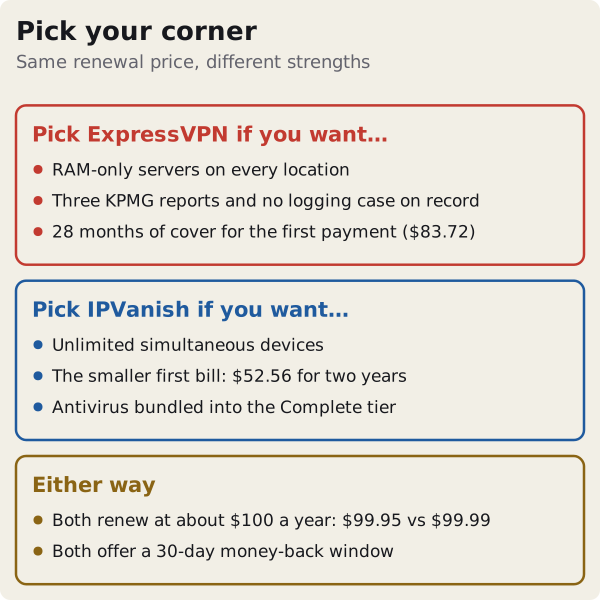
Take ExpressVPN if you want the stronger privacy architecture: RAM-only servers everywhere, three KPMG reports, and no logging case in its history. Take IPVanish if you need unlimited devices and the lower first bill, accept a US base, and are satisfied by its 2025 Schellman audit that today's service matches its no-logs promise. On a pure renewal basis it's a coin toss; on trust, ExpressVPN has the edge. You can check ExpressVPN's plans or check IPVanish's plans; both are affiliate links, and neither changes this verdict.
For another view of IPVanish against a stronger-audited rival, read IPVanish vs NordVPN, or go back to the full VPN comparisons hub.
Cornerside questions
Is ExpressVPN better than IPVanish?
Which is cheaper, ExpressVPN or IPVanish?
Does IPVanish keep logs?
How many devices can I use with ExpressVPN and IPVanish?
Do both offer a money-back guarantee?
Affiliate links. We may earn a commission if you subscribe — it never changes who wins a round.
Zoom out: see how this sits in every VPN matchup, compared, or weigh the NordVPN vs Surfshark vs ExpressVPN three-way.